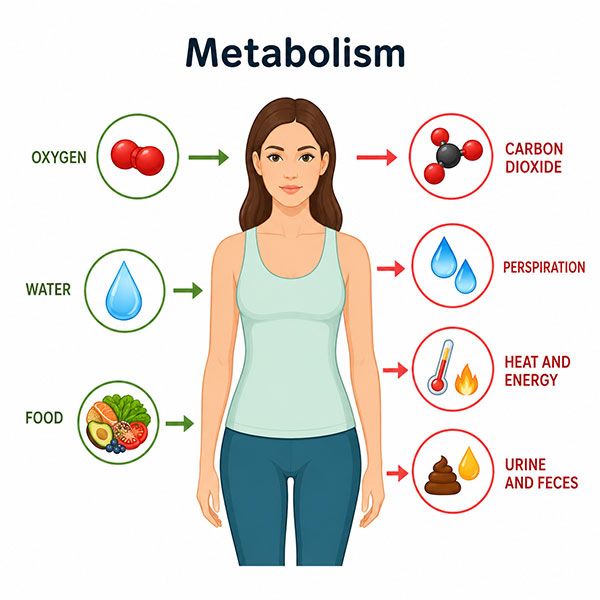
Microcirculation and Metabolism
The true work of metabolism takes place within the capillaries.
These microscopic vessels connect the bloodstream with the tissues. Through their thin walls, the cells receive nourishment and release waste products for elimination.
This process is known as microcirculation.
Healthy microcirculation supports:
- Oxygen delivery
- Nutrient transport
- Cellular energy production
- Detoxification processes
- Lymphatic circulation
- Heat exchange
- Recovery and regeneration
- Natural metabolic activity
Without healthy blood circulation, metabolism slows not only in one organ, but throughout the organism as a whole.
Detoxification Depends on CirculationThe body possesses several natural pathways of elimination.
The lungs eliminate gases.
The kidneys eliminate dissolved waste products.
The intestines eliminate digestive waste.
And the skin participates actively through perspiration.
The skin as one of the body's largest circulatory and excretory organs. Millions of capillaries lie beneath its surface, continuously exchanging heat, fluids, and metabolic substances with the bloodstream.
When circulation becomes more active, these processes become more active as well.
For this reason, circulation and detoxification are inseparable physiological functions.
Turpentine Bath Therapy and Detoxification Through the Skin was developed specifically to stimulate the capillary circulation of the skin.
During a properly prepared turpentine bath, the body enters a state of intense physiological activity. Heat increases, blood flow rises, capillary circulation becomes more dynamic, and perspiration intensifies.
This warming response has traditionally been associated with:
- Detox bath therapy
- Microcirculation support
- Healthy blood flow
- Metabolism support
- Lymphatic circulation
- Detoxification through sweating
- Recovery and relaxation
- Whole-body hydrotherapy
Unlike ordinary bathing, turpentine hydrotherapy was designed as a circulation-focused method acting upon the organism as a whole.
Heat, Perspiration, and Metabolic Activity
Heat plays an important role in human physiology.
As circulation increases and the body warms, metabolic activity also becomes more active. The skin begins to perspire more intensely, blood vessels expand, and the transport of substances through the capillary network accelerates.
The Skin as an Organ of Elimination
Modern wellness discussions often underestimate the physiological importance of the skin.
Yet the skin contains one of the body's richest vascular networks and participates continuously in circulation, temperature regulation, detoxification, and perspiration.
Traditional detox bath therapy works directly through this capillary surface.
By stimulating circulation in the skin, turpentine baths encourage the body's natural processes of exchange and elimination through sweating.
This principle stood at the center of Zalmanov's capillary therapy philosophy
A Whole-Body Approach to Detox & MetabolismThe organism cannot be divided into isolated compartments.
Every tissue depends upon circulation.
Every metabolic process depends upon microcirculation.
Every living cell depends upon the continuous balance between nourishment and elimination.
This is why traditional circulation therapy does not focus on a single organ or symptom. It focuses on the common pathway that connects the entire body: the circulatory system.