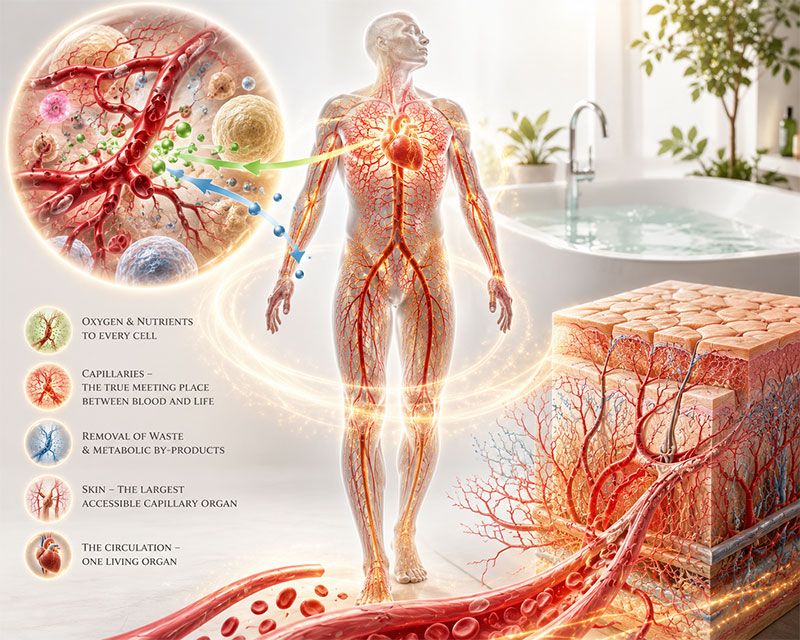
The Circulatory System Is One Living Organ
The human circulatory system is often described as separate parts:
• the heart,
• the arteries,
• the veins,
• the capillaries.
Dr. Zalmanov believed this division hides a fundamental truth.
The circulation functions as one integrated living organ.
The heart creates pressure.
The arteries transport blood.
The veins return it.
But only the capillaries complete the purpose of circulation.
Within these microscopic vessels oxygen enters the tissues.
Nutrients reach the cells.
Carbon dioxide begins its return.
The products of cellular metabolism leave the tissues.
Life itself exists only where blood meets the cell.
Where Life Truly Happens
Every second, billions of cells consume oxygen.
Every second, they transform nutrients into energy.
Every second, they produce metabolic by-products that must be removed.
This continuous exchange takes place inside the capillary network.
Without healthy capillary circulation:
•oxygen delivery slows,
•cellular nutrition declines,
•metabolic waste accumulates,
•normal tissue renewal becomes less efficient.
For Dr. Zalmanov, disease often began when this microscopic exchange gradually weakened.
The Forgotten Millions of Peripheral Hearts
Long before modern imaging technologies revealed the complexity of the microcirculation, physiologists had already recognized that the smallest blood vessels were remarkably dynamic.
In The Secret Wisdom of the Human Body, Dr. Zalmanov referred to the work of
Henri Huchard, Rouget, Tinel, and Clarke, who described the capillary network as an immense system of
"peripheral hearts."
"As early as 1908, Huchard established the importance of innumerable peripheral hearts. Rouget emphasized the muscular character of the cells that bear his name. For Tinel, the Rouget cells constitute a neuromuscular apparatus. Capillary contractions - rhythmic capillary systoles—are indisputable for both Tinel and Clarke."
These scientists believed that the smallest vessels actively participated in the movement and regulation of blood rather than serving as passive channels.
Modern physiology explains this process differently today.
The importance of the microcirculation remains the same.
The Skin: The Largest Accessible Capillary Organ
One of Dr. Zalmanov's greatest insights was recognizing the skin as far more than a protective covering.
The skin contains millions of functioning capillaries.
• It regulates body temperature.
• It participates in circulation.
• It removes water, salts, and metabolic by-products through perspiration.
• It constantly communicates with the entire vascular system.
For Zalmanov, stimulating the capillaries of the skin meant influencing the circulation of the whole organism.
This simple but revolutionary idea became the foundation of his therapeutic method.
Why Dr. Zalmanov Developed Turpentine BathsIf healthy circulation depends upon healthy capillaries, how can they be supported?
Dr. Zalmanov answered this question with one of the most original forms of hydrotherapy ever developed.
Traditional White and Yellow Turpentine Bath Emulsions were designed to create a controlled physiological response.
Warm water gently dilates the skin vessels.
The emulsions stimulate the capillary network.
The skin becomes warm.
Perspiration begins.
According to Zalmanov, these responses encouraged the restoration of active circulation throughout the body.
His goal was never simply to warm the skin.
His goal was to awaken the circulation.
Opening the Closed CapillariesThroughout his writings, Dr. Zalmanov repeatedly described one essential objective:
"Opening closed capillaries, the influx of oxygen... removal of metabolites..."
These few words summarize his entire philosophy.
Healthy tissues require three continuous processes:
• Oxygen delivery
• Nutrient supply
• Removal of metabolic waste
Every one of these depends upon the capillary network.
When these processes remain active, tissues preserve their vitality.
A Modern Physiological Perspective
Today's understanding of vascular biology is far more detailed than it was during Dr. Zalmanov's lifetime.
We now recognize the essential roles of endothelial function, nitric oxide signaling, autonomic regulation, tissue perfusion, and microvascular physiology.
Yet one of Zalmanov's central ideas remains remarkably relevant:
Healthy circulation is not measured only by the heartbeat or blood pressure.
It is measured by how effectively blood reaches every living cell.
Modern physiology and Zalmanov's philosophy meet at this point:
Microcirculation matters.
The Zalmanov Method Today
Traditional Turpentine Bath Therapy continues to follow the same principle that inspired Dr. Zalmanov more than a century ago.
Rather than concentrating on a single symptom, it focuses on supporting the body's natural circulatory processes through the extensive capillary network of the skin.
Our White and Yellow Turpentine Bath Emulsions are prepared according to the original principles of Dr. Zalmanov's method.
They are intended to support:
• Healthy blood circulation
• Active microcirculation
• Oxygen delivery
• Cellular nutrition
• Natural perspiration
• Removal of metabolic by-products
• Physiological recovery
• Whole-body vascular wellness
The philosophy remains unchanged.
Support the circulation.
Support the organism.
The Zalmanov Principle
"The heart begins the circulation.
The capillaries sustain life." FAQWhat is capillary therapy?
Capillary therapy is Dr. Alexander Zalmanov's concept of supporting health by improving microcirculation—the exchange of oxygen, nutrients, and metabolic by-products between blood and tissues through the capillary network.
Why did Dr. Zalmanov focus on capillaries?
He believed that every organ depends on healthy capillary circulation because only capillaries deliver oxygen and nutrients directly to cells and remove metabolic waste.
How do turpentine baths fit into this philosophy?
According to Dr. Zalmanov, traditional White and Yellow Turpentine Bath Emulsions were developed to stimulate the skin's extensive capillary network, promoting whole-body circulatory responses through hydrotherapy.
Can I use hardware store turpentine for baths?No. Industrial turpentine, paint thinner, mineral turpentine, and technical solvents should never be confused with traditional Zalmanov bath emulsions.