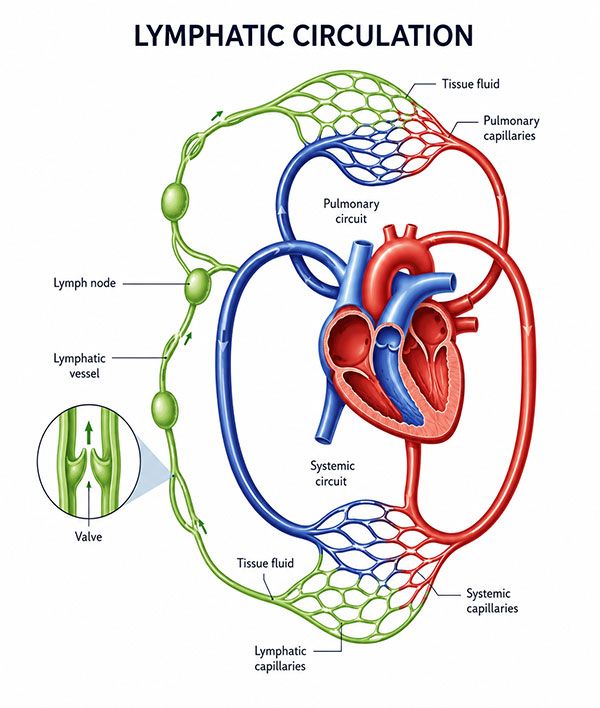
The Relationship Between Microcirculation and Lymphatic FlowEvery second, fluid leaves the capillaries and enters the surrounding tissues.
This fluid carries oxygen, nutrients, minerals, and countless substances required by the cells.
Not all of this fluid returns directly to the bloodstream.
A portion enters the lymphatic vessels, becoming lymph.
The lymphatic system then transports this fluid, together with cellular waste products and metabolic by-products, back toward the circulation.
Healthy lymphatic circulation begins with healthy microcirculation.
Without active capillary blood flow, the movement of lymph becomes less efficient.
For this reason, microcirculation and lymphatic circulation cannot be separated.
They are parts of the same continuous process of exchange.
The Body's Natural Cleansing System
The body constantly produces waste materials through metabolism.
Every cell generates by-products that must be removed.
The circulatory and lymphatic systems work together to transport these substances toward the organs of elimination.
Healthy circulation supports:
- Lymphatic drainage
- Tissue fluid balance
- Microcirculation
- Cellular exchange
- Metabolic activity
- Recovery and regeneration
- Detoxification processes
- Vascular health
The more efficient this exchange becomes, the more efficiently the organism maintains its internal environment.
The Skin, Circulation, and Lymphatic Support
Dr. Zalmanov viewed the skin as far more than a protective covering. The skin contains millions of capillaries, extensive lymphatic vessels, sweat glands, and an enormous surface through which the body exchanges heat and fluids with its environment.
When circulation in the skin becomes more active, the movement of fluids throughout the tissues also becomes more active.
For this reason, the skin occupies a central position in traditional circulation therapy.
Turpentine Bath Therapy and Lymphatic Circulation
During a properly prepared turpentine bath, blood flow increases, microcirculation becomes more active, tissues warm, and perspiration intensifies.
This circulatory response influences the movement of fluids throughout the body and has traditionally been associated with support for healthy lymphatic circulation.
For generations, turpentine bath therapy has been used as a form of hydrotherapy associated with:
- Lymphatic circulation support
- Natural detox bath therapy
- Microcirculation support
- Improved blood circulation
- Detoxification through sweating
- Metabolism support
- Recovery and relaxation
- Whole-body wellnessrpentine Bath Therapy and Lymphatic Circulation